Complete Article
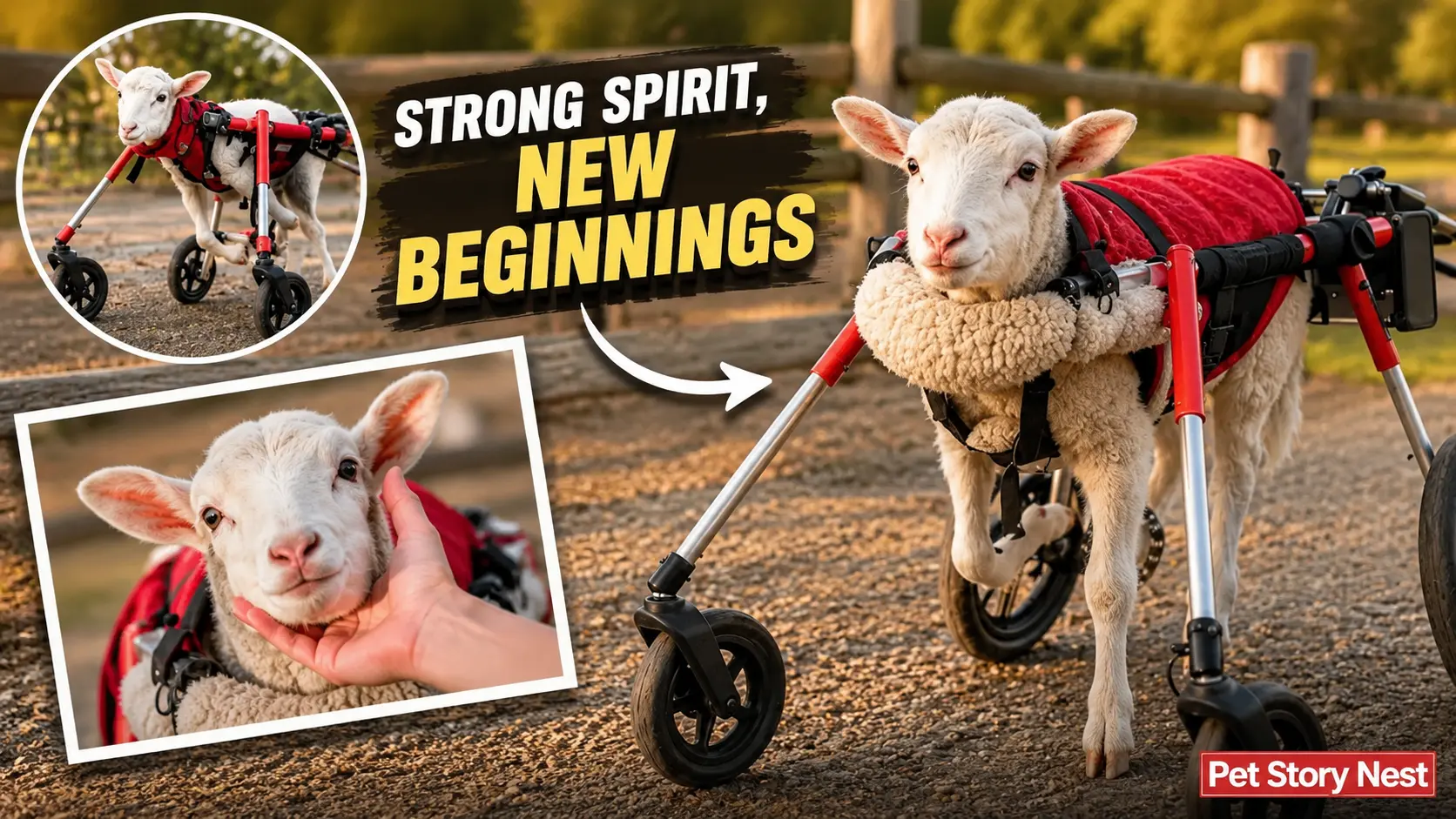
For Kiki, a small disabled sheep in Massachusetts, getting around was once almost impossible. Born with severe physical disabilities that left her unable to use her legs normally, she spent much of her early life dependent on people for basic movement.
Today, Kiki has something very different: independence. After years of care, therapy and creative problem-solving, she learned to operate a motorized wheelchair herself, using her head to control a joystick. Her unusual journey has attracted widespread attention because it shows how patience, technology and compassion can transform an animal’s quality of life.
Kiki’s difficult beginning
Kiki was born in 2021 with serious mobility problems. Reports have linked her condition to Cache Valley virus, which can cause neurological and musculoskeletal abnormalities in developing lambs. Her legs were severely affected and could not be straightened enough for her to stand and walk normally.
Her mother rejected her after birth, leaving Kiki vulnerable and unable to receive the care and nutrition she needed. At only 11 days old, she was taken in by Don’t Forget Us, Pet Us, a sanctuary in Dartmouth, Massachusetts, where she became part of a group of rescued animals with special needs.
When she arrived, Kiki was weak and severely undernourished. She had spent much of her young life lying down, which created additional physical challenges and made rehabilitation even more important.
From therapy to a wheelchair
The first goal was not to teach Kiki how to drive. It was simply to give her a chance to stand upright and improve her mobility.
A wheelchair donated through Walkin’ Pets helped support her body and allowed her caregivers and therapists to work with her more effectively. In 2022, the sanctuary reported that the wheelchair allowed Kiki to stand during therapy and gave her a new opportunity to strengthen her legs.
At that stage, the wheelchair was mainly a mobility and rehabilitation tool. Kiki still depended on people to move it.
But her caregivers eventually noticed something remarkable about the way she interacted with toys.
Kiki discovers how to control things
Kiki showed an interest in simple press-and-play toys, which she could activate using her head. Her caregivers noticed that she appeared to understand cause and effect: when she pushed the toy in a particular way, something happened.
That observation eventually inspired a much bigger idea.
If Kiki could deliberately operate a toy, perhaps she could also learn to control a powered mobility device.
Her caregivers worked with mobility specialists and supporters to create a setup that would allow her to operate a motorized wheelchair without using her legs or hands. The joystick was positioned so Kiki could reach it with her head.
The result was a highly customized wheelchair that gave Kiki something she had never truly had before: control over where she went.
The moment Kiki learned to drive
When Kiki was introduced to the motorized wheelchair, her progress surprised the people around her.
Rather than simply sitting in the chair, she quickly began experimenting with the joystick. By nudging it with her head, she could make the wheelchair move and change direction.
According to reports from the sanctuary, Kiki learned the basic cause-and-effect relationship remarkably quickly. What began as an experiment became a practical way for her to move independently around the sanctuary.
For Kiki’s caregivers, the achievement was about much more than an unusual viral video. The wheelchair gave her an opportunity to explore her surroundings instead of always waiting for someone else to move her.
That independence is what makes her story so powerful.
Why Kiki’s wheelchair matters
Assistive equipment can make a major difference for animals with mobility problems. Wheelchairs, braces, harnesses and other forms of support can help some disabled animals stand, exercise, explore their environment and participate in activities that would otherwise be difficult or impossible.
Kiki’s story demonstrates one particularly important point: mobility assistance does not necessarily have to mean that someone else controls the animal’s movement.
Her customized system was designed around what Kiki could do rather than focusing only on what she could not do. Her ability to use her head became the key to creating a practical form of independence.
More than an inspiring animal story
Kiki’s journey has also resonated with people with disabilities and their families.
Her sanctuary has received messages from parents who said their children found encouragement in watching Kiki use her wheelchair. According to local reporting, some families saw her as a positive example for children who also rely on mobility equipment.
That response gives Kiki’s story a wider meaning. Her experience is not a lesson that disability can simply be overcome through determination. Instead, it highlights the importance of adapting the environment and providing the right tools so that individuals can participate more independently.
For Kiki, the right tool happened to be a specially adapted motorized wheelchair.
Kiki continues to enjoy life
Life at the sanctuary is not limited to rehabilitation sessions. Reports describe Kiki enjoying time with other rescued animals and taking part in different activities.
Her caregivers have also used enrichment activities to keep her mentally engaged. She has been described interacting with toys, enjoying music and spending time with her animal companions.
Her wheelchair has therefore become more than a piece of equipment. It has become part of her everyday life and a way for her to participate in the world around her.
The sight of a sheep confidently navigating a motorized chair may seem extraordinary, but the story behind it is even more meaningful.
A small lamb with a big lesson
Kiki’s journey from a vulnerable newborn to an independently mobile sheep is a reminder of what can happen when caregivers look for possibilities instead of limitations.
She cannot walk like other sheep, but that does not mean she cannot explore, learn or enjoy her surroundings. With specialized care and technology suited to her abilities, Kiki has found a form of freedom that once seemed out of reach.
Her story continues to inspire animal lovers because it is ultimately about more than a wheelchair. It is about giving a vulnerable animal the opportunity to live with dignity, independence and joy.