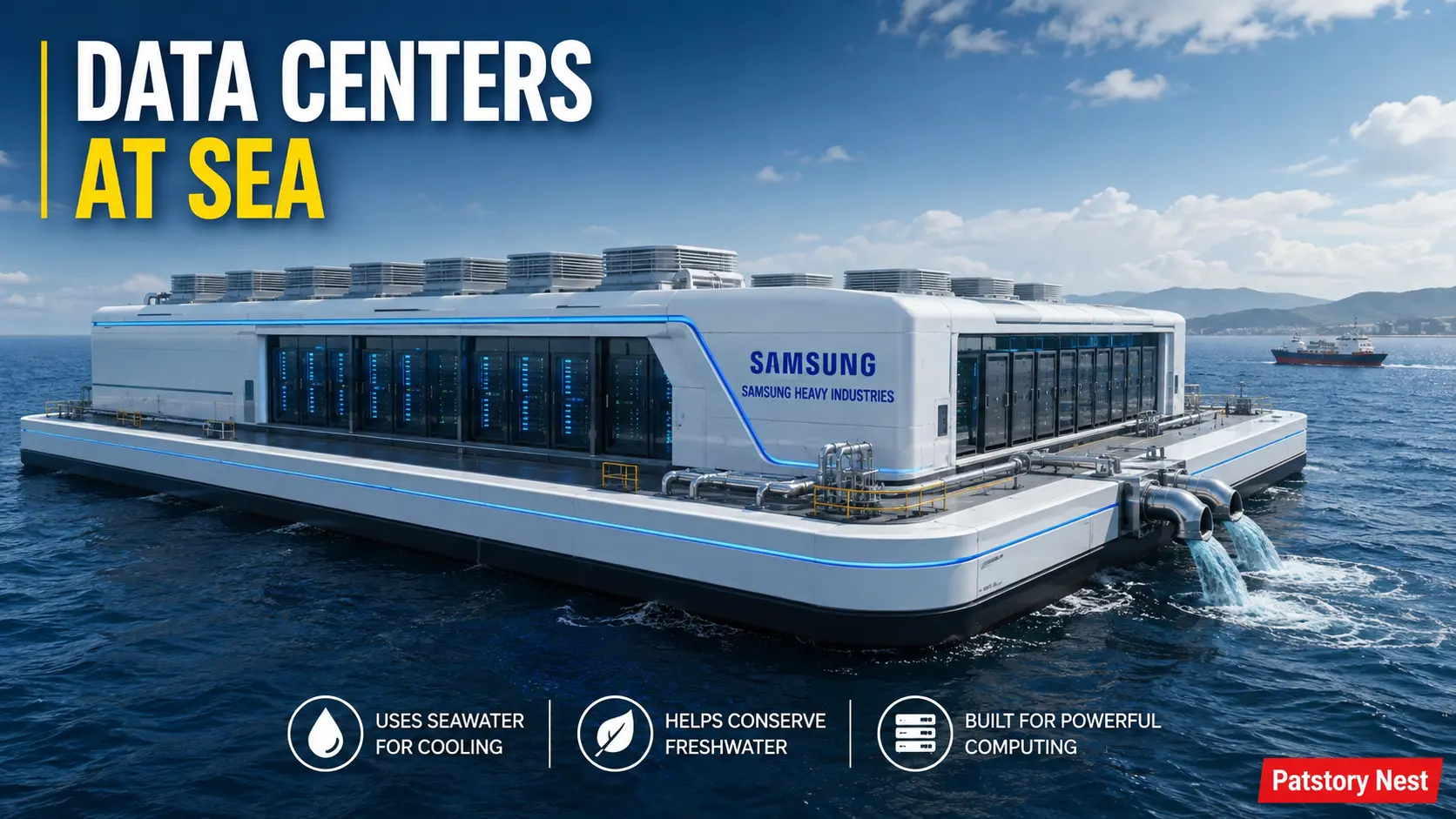
The race to build more powerful data centers is pushing the industry beyond traditional land-based facilities. Samsung Heavy Industries (SHI) is developing a different approach: floating data centers designed to operate on rivers or at sea, where access to seawater and offshore infrastructure could help address some of the biggest challenges facing conventional facilities.
The South Korean shipbuilder’s concept combines marine engineering with data-center technology. Its proposed floating data centers are intended to provide computing capacity while reducing pressure on scarce land, electricity infrastructure and cooling resources.
The project has moved beyond an early concept stage. In April 2026, SHI announced that its 50-megawatt floating data-center design had received Approval in Principle from the American Bureau of Shipping and Lloyd’s Register.
Why Samsung Heavy Industries Is Building Floating Data Centers
The rapid expansion of artificial intelligence has created enormous demand for computing infrastructure. Modern AI systems require data centers filled with high-performance servers, and those servers generate substantial amounts of heat.
Traditional data centers therefore need reliable electricity, large sites and sophisticated cooling systems. Finding suitable locations and securing enough power can be difficult, particularly in areas where demand for digital infrastructure is already high.
SHI believes placing data centers on water could offer another option.
A floating data center is essentially a specialized marine structure containing server halls, electrical equipment and supporting infrastructure. Instead of constructing the entire facility on land, the computing equipment would be integrated into a purpose-built floating platform or barge.
According to SHI, the concept is intended to address challenges involving site availability, electricity supply and heat dissipation.
How the Floating Data Center Could Use Seawater
One of the most interesting parts of the concept is its cooling system.
Data-center servers produce large amounts of heat, making cooling one of the most important parts of operating a computing facility. SHI’s floating data-center design incorporates seawater cooling, potentially allowing the surrounding water to become part of the facility’s thermal-management strategy.
A June 2026 announcement from Capital Clean Energy Carriers, which is working with SHI and Lloyd’s Register on floating data-center designs, confirmed that the concept includes seawater cooling and onboard power generation.
The approach could reduce dependence on freshwater resources used by some land-based cooling systems. That does not mean the technology automatically eliminates environmental concerns, however. A commercial facility would still need to manage water intake, discharge, corrosion, marine conditions and other engineering challenges.
The advantage is that the ocean or another suitable body of water could provide a potentially valuable cooling resource close to the computing equipment.
A 50-Megawatt Design Is Already Under Development
SHI has developed a 50-megawatt floating data-center concept and received Approval in Principle from two major classification organizations.
Approval in Principle is an important development because it indicates that the proposed design has undergone technical assessment against relevant requirements. It is not the same as having a completed commercial data center operating at sea.
SHI says its design uses standardized shipbuilding processes, allowing design, manufacturing and equipment integration to be handled using methods already familiar to the shipbuilding industry.
The company has also been building partnerships around the technology.
In June, SHI announced cooperation with Greek shipping company Capital Clean Energy Carriers and Lloyd’s Register. Under the agreement, SHI is responsible for technology development and construction, while Capital is involved in project sourcing and investment and Lloyd’s Register contributes to technical and regulatory work.
The Biggest Challenge: Running Servers at Sea
Putting servers on water is considerably more complicated than simply placing a conventional data center on a floating platform.
Marine environments expose electronic equipment to vibration, movement, humidity and salt. These conditions can affect equipment reliability and potentially shorten the operating life of sensitive computing hardware if they are not properly controlled.
SHI has acknowledged these challenges and is working with AI-server specialist Supermicro to investigate the operation of servers in marine and river environments.
The companies are developing technologies related to positioning control and protection against humidity and salt exposure. Supermicro is also involved in validating AI-server operations in water-based environments.
That testing will be important because a data center cannot simply be judged by whether it can float. It must also provide stable, secure and predictable conditions for expensive computing equipment operating continuously.
Samsung Heavy Industries Is Targeting 2028
The project has also gained a more specific commercialization timeline.
In July 2026, reports said Samsung Heavy Industries was targeting the second quarter of 2028 for commercialization of its floating data-center platform. The company said it was pursuing multiple feasible projects as it works toward that goal.
The initial model is expected to be a nearshore facility rather than a completely remote structure operating far offshore. Reports indicate that SHI is designing a dedicated newbuild barge containing data halls, mechanical and electrical systems and power-generation equipment.
That distinction matters. A nearshore facility could potentially simplify connections to existing infrastructure while still taking advantage of the space and cooling opportunities offered by water.
Could Floating Data Centers Become the Next AI Infrastructure?
Floating data centers are still an emerging technology, so it is too early to say whether they will become a major replacement for traditional data centers.
There are clear potential advantages. Facilities could avoid some land constraints, use established shipbuilding techniques and potentially benefit from seawater cooling. Offshore deployment could also provide another pathway for expanding computing capacity as AI demand continues to grow.
At the same time, the technology faces major questions around cost, maintenance, environmental impact, connectivity, regulation, security and long-term server reliability.
SHI’s partnerships suggest that solving those problems will require more than shipbuilding expertise alone. It will involve data-center operators, server manufacturers, investors, classification organizations and technology companies.
For now, Samsung Heavy Industries’ floating data-center project represents an intriguing experiment at the intersection of two rapidly expanding industries: maritime engineering and AI computing.
If the technology can prove reliable and economically viable, the data center of the future may not always need to stand on solid ground. Some computing infrastructure could eventually operate alongside ships and offshore energy facilities, using the surrounding water as part of the system that keeps powerful AI hardware running.