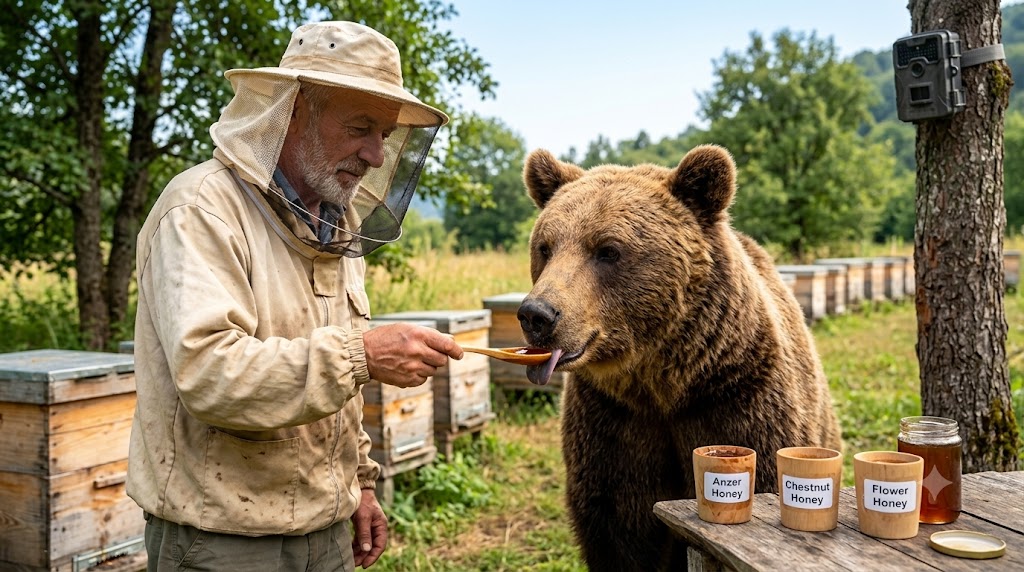
Imagine spending months caring for your beehives, only to wake up and find them smashed apart overnight. That was the reality for Ibrahim Sedef, a beekeeper from Trabzon, Turkey, whose prized honey became an irresistible target for hungry brown bears.
For years, Sedef tried almost everything he could think of to protect his hives. He built sturdy iron cages around them, hoping the barriers would keep the powerful animals away. When that didn’t work, he placed fruit nearby as a distraction, believing the bears might settle for an easier meal.
The bears had other plans.
They ignored the fruit, found ways around the cages, and headed straight for the honey every single time. Instead of giving up or seeing the bears as enemies, Sedef made an unexpected decision. If he couldn’t outsmart the bears, perhaps he could learn from them.
That simple shift in thinking led to one of the most fascinating wildlife stories in recent years.
The Turning Point
After countless damaged beehives, Ibrahim Sedef decided that guessing wasn’t enough. He wanted to understand exactly how the bears operated.
He installed night vision photo trap cameras around his apiary to capture every nighttime visit. Rather than frightening the bears away, the cameras quietly recorded their behavior.
The footage revealed something remarkable.
The bears were patient, intelligent, and surprisingly methodical. They inspected the area carefully before approaching the hives. Once they found an opening, they worked with impressive strength and determination to reach the honey inside.
Watching hours of footage changed Sedef’s perspective.
Instead of viewing the bears as destructive pests, he began to see them as clever wild animals simply following their instincts. Their actions weren’t driven by malice. They were looking for one of nature’s richest food sources.
That realization inspired an idea that was equal parts scientific experiment and lighthearted curiosity.
From Thieves to Taste Testers
Rather than trying another defense system, Ibrahim Sedef decided to test the bears’ preferences.
He arranged a table containing four different types of honey:
- Premium Anzer Honey
- Chestnut honey
- Flower honey
- Cheap commercial honey
The setup was simple.
If the bears truly didn’t care about quality, they would probably eat whichever honey they reached first.
But if they had preferences similar to human food lovers, the results could be far more interesting.
The cameras rolled once again as night fell over the hills of Trabzon.
When the bears arrived, they walked directly toward the table and began sampling the different options.
What happened next surprised everyone.
The Hilarious Results
The bears consistently chose the premium Anzer Honey first.
Known as one of Turkey’s most valuable and sought-after honeys, Anzer Honey is produced in the famous Anzer Plateau, where bees collect nectar from hundreds of unique alpine flowers.
The bears appeared to recognize its quality immediately.
Only after finishing the premium honey did they move on to the other varieties. Chestnut honey generally came next, followed by flower honey.
The inexpensive commercial honey was often ignored until there was little else left to eat.
The unexpected “taste test” quickly captured public attention.
People joked that the bears had become gourmet food critics with expensive tastes. Others laughed that the animals seemed capable of identifying premium honey better than many people could.
While the experiment was entertaining, it also demonstrated something important.
Wild animals often make surprisingly selective food choices based on smell, nutritional value, and natural instincts rather than simply eating whatever is available.
Why Do Bears Crave Honey? The Science Explained
The story is amusing, but there is solid biology behind the bears’ behavior.
Brown bears need enormous amounts of energy, especially before winter. Their survival depends on building fat reserves that can sustain them through long periods when food becomes scarce.
Several scientific factors explain their attraction to beehives:
- Honey is packed with calories. The natural sugars provide quick energy that helps bears accumulate body fat before winter.
- Bee larvae provide valuable protein. Bears are not interested in honey alone. They also eat developing bee larvae, which are rich in nutrients needed for muscle maintenance and overall health.
- Their sense of smell is extraordinary. Bears can detect food from remarkable distances, making beehives difficult to hide.
- Wild animals seek the highest nutritional reward. Foods that offer more energy with less effort naturally become preferred choices.
- Seasonal feeding is essential. During late summer and autumn, bears spend much of their time searching for calorie-dense foods to prepare for colder months.
These instincts have developed over thousands of years and play a vital role in helping bears survive in the wild.
Coexisting with Wildlife
Many conflicts between people and wildlife arise because humans and animals rely on the same natural resources.
For beekeepers, damaged hives represent lost income and months of hard work. For bears, those same hives are simply another source of food.
Ibrahim Sedef’s response stands out because he chose curiosity instead of anger.
By observing the bears rather than immediately trying to eliminate the problem, he gained valuable insight into their behavior while sharing a story that inspired people around the world.
His experiment doesn’t solve every challenge between humans and wildlife, but it reminds us that understanding often leads to better solutions than conflict alone.
Across many parts of the world, farmers, conservationists, and local communities continue exploring ways to reduce encounters between people and wild animals. Stronger fencing, improved hive designs, careful land management, and better monitoring systems can all help protect livelihoods while allowing wildlife to thrive.
The image of bears carefully selecting the finest honey may seem funny at first, but it carries a deeper message.
Nature is full of intelligence, instinct, and unexpected surprises. Sometimes the best way to appreciate wildlife isn’t by fighting against it, but by taking the time to understand it.
The bears of Trabzon unknowingly became unlikely taste testers, and Ibrahim Sedef transformed years of frustration into a story that continues to make people smile while encouraging a more thoughtful relationship between humans and the natural world.