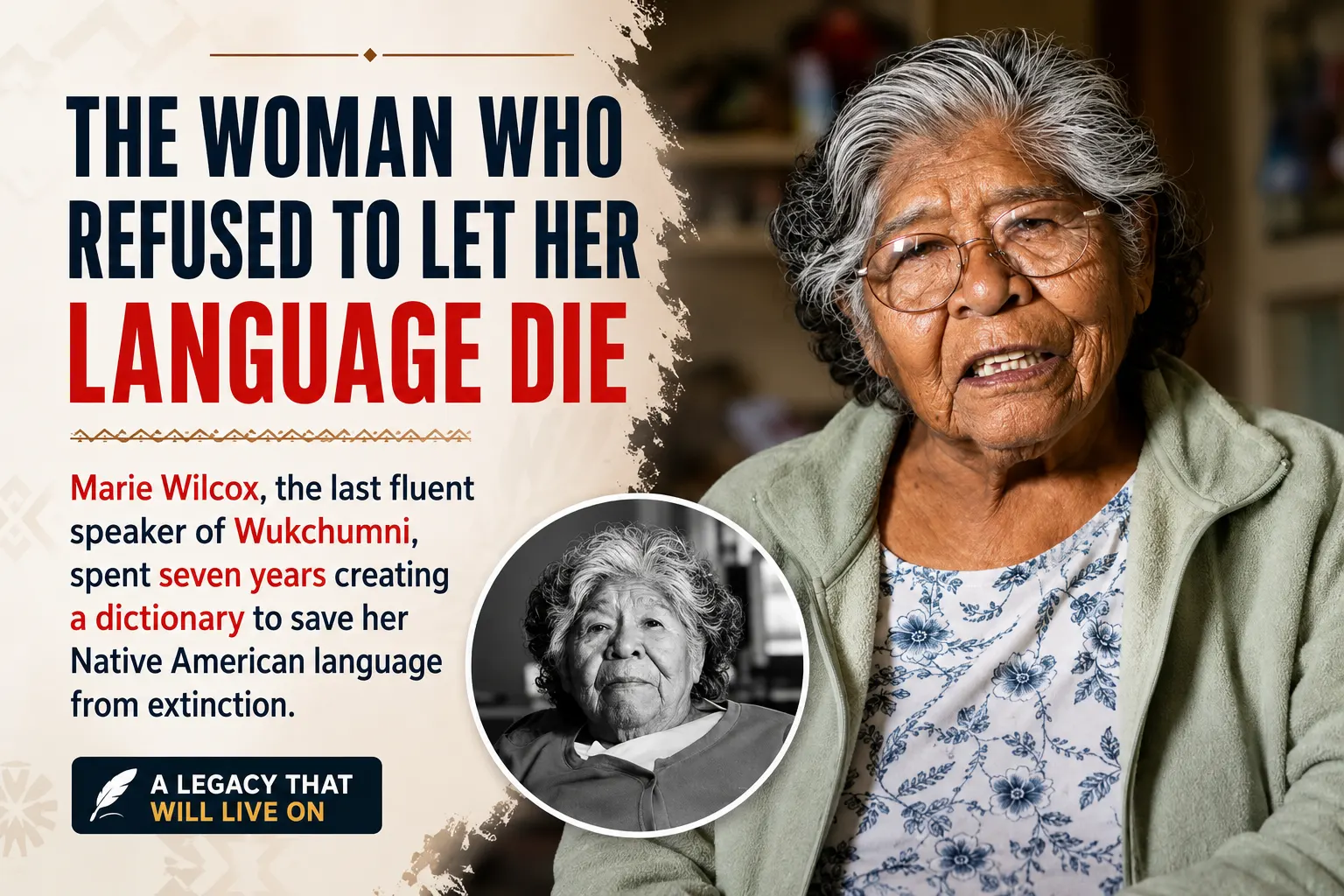
The Woman Who Refused to Let Her Language Die
Languages are more than words. They carry history, traditions, stories, and the identity of entire communities. When a language disappears, generations of knowledge can vanish with it. That was the reality facing the Wukchumni language, a Native American language once spoken by the Wukchumni people of California.
Marie Wilcox understood what was at stake better than anyone. As the last fluent speaker of Wukchumni, she carried the weight of an entire culture on her shoulders. Rather than accepting that her ancestral language would be lost forever, she dedicated the final decades of her life to preserving it. Her determination transformed a personal mission into one of the most inspiring language preservation stories in modern history.
Who Was Marie Wilcox?
Marie Wilcox was a member of the Wukchumni Tribe, one of the Yokuts Indigenous peoples of California. She grew up speaking Wukchumni as a child, but over time the language faded as English became dominant and younger generations no longer learned their ancestral tongue.
By the early 21st century, Wilcox realized she was the only person left who could speak the language fluently. The realization was heartbreaking, but instead of mourning its decline, she chose to act.
Her mission became simple yet extraordinary: ensure that future generations would still have a way to learn Wukchumni.
Learning New Skills in Her 80s
Many people assume that learning new technology becomes impossible with age. Marie Wilcox proved otherwise.
In her 80s, she learned how to use a computer despite having little previous experience. Friends and family helped her understand the basics, allowing her to begin recording the language that existed almost entirely in her memory.
For nearly seven years, she carefully typed thousands of words, spellings, pronunciations, and meanings into a digital dictionary. The work demanded patience, accuracy, and countless hours of dedication.
It wasn’t simply about translating words—it was about preserving a culture.
Creating the First Wukchumni Dictionary
Marie Wilcox’s greatest achievement was compiling the first comprehensive Wukchumni dictionary.
The dictionary documented thousands of entries and became an invaluable educational resource. It gave younger members of the Wukchumni community a foundation for learning the language that might otherwise have disappeared forever.
Language experts often explain that documentation is one of the most effective ways to preserve endangered languages. A well-prepared dictionary allows future educators, linguists, and community members to rebuild language programs even after fluent speakers are gone.
Wilcox’s work created exactly that opportunity.
Why Indigenous Languages Matter
Every Indigenous language reflects a unique way of understanding the world.
Many Native American languages contain words for local plants, wildlife, landscapes, ceremonies, and traditions that have no direct English equivalent. Losing those languages means losing knowledge developed over centuries.
According to UNESCO, thousands of languages around the world are considered endangered, with many expected to disappear during this century if preservation efforts are not successful.
Marie Wilcox’s work became an example of how one individual can help protect an irreplaceable cultural heritage.
Inspiring a New Generation
The completion of the Wukchumni dictionary sparked renewed interest in the language among younger tribal members.
Community efforts have since focused on teaching children and adults using the materials Wilcox created. While rebuilding a language is a long process, having reliable educational resources makes revival possible.
Her story has also inspired linguists, educators, and Indigenous communities across North America who face similar challenges preserving endangered languages.
It demonstrates that preserving culture often begins with the dedication of a single person.
International Recognition
Marie Wilcox’s remarkable journey attracted attention far beyond California.
Her work was featured in documentaries, educational projects, and news reports highlighting the importance of language preservation. Audiences around the world admired her determination to learn modern technology late in life for a cause she believed in deeply.
Rather than seeking recognition, Wilcox remained focused on protecting her community’s heritage.
That humility became part of what made her story so powerful.
A Legacy That Lives Beyond Words
Marie Wilcox passed away in 2021, but her influence continues.
Because she refused to let Wukchumni disappear without a fight, future generations now have a chance to reconnect with a language that once stood on the edge of extinction.
Her dictionary serves not only as a learning tool but also as a symbol of resilience, reminding people that preserving culture is possible even in the face of overwhelming odds.
Final Thoughts
Marie Wilcox’s story is not simply about saving a language—it is about protecting identity, history, and community.
When she realized she was the last fluent speaker of Wukchumni, she chose hope over despair. By learning computer skills in her 80s and spending years documenting thousands of words, she ensured that her people’s voice would continue to be heard long after her lifetime.
Her remarkable dedication reminds us that one determined individual can make an extraordinary difference. Thanks to Marie Wilcox, the Wukchumni language remains a living part of history rather than a forgotten chapter, inspiring language preservation efforts around the world for generations to come.