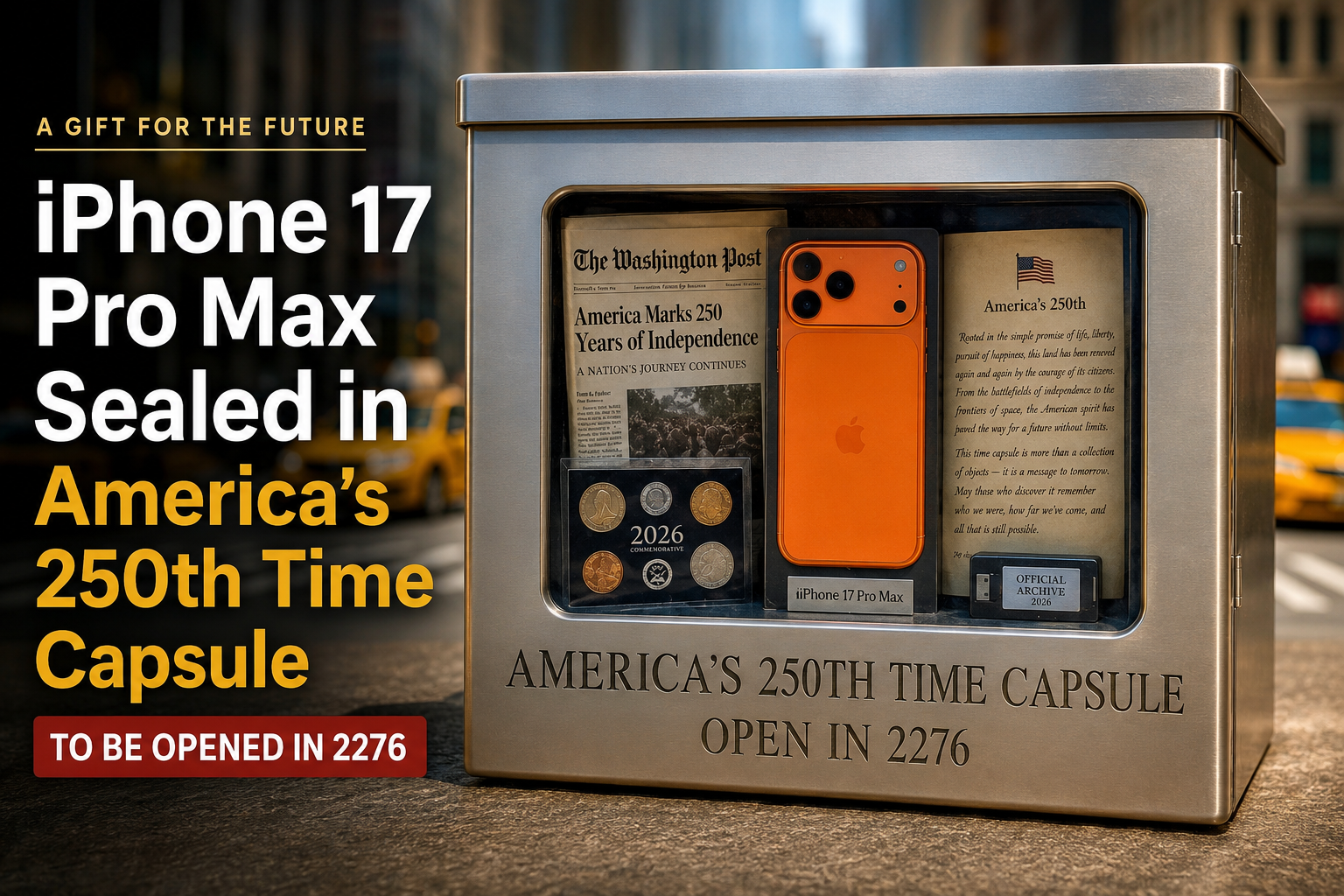
Imagine living in the year 2276 and opening a time capsule that has remained untouched for 250 years. Among historic documents, commemorative coins, and messages from the past, you discover an iPhone from 2026—a device that once represented cutting-edge technology but has become a priceless artifact of everyday life in the early 21st century.
That fascinating idea has captured the internet’s attention after reports that an iPhone from 2026 is being included in a time capsule created to mark America’s 250th anniversary. Whether future generations will be able to power it on is anyone’s guess, but its symbolic value is already sparking conversations about history, technology, and how today’s digital world will be remembered centuries from now.
Why an iPhone Belongs in a Time Capsule
Every generation leaves behind objects that define its era. Ancient civilizations left pottery, tools, and handwritten manuscripts. Modern society leaves behind smartphones, wearable devices, and digital memories.
An iPhone is far more than a communication device. It represents how people in 2026 worked, learned, traveled, entertained themselves, captured family moments, and stayed connected with friends around the globe.
Future historians may see it as one of the defining inventions of the 21st century, much like we view the printing press or the first personal computers today.
Celebrating America’s 250th Anniversary
The year 2026 marks 250 years since the signing of the Declaration of Independence in 1776. Across the United States, commemorative projects are expected to celebrate the nation’s history, achievements, and cultural evolution.
Time capsules have long been part of milestone celebrations. They preserve everyday objects so future generations can better understand what life was really like rather than relying only on written records.
Including modern technology helps paint a more complete picture of American life during this historic anniversary.
What Future Generations Might Discover
Opening a sealed capsule in 2276 would be like stepping into a museum designed specifically for people living hundreds of years later.
If the smartphone remains physically intact, people of the future could examine:
- The hardware design and materials.
- The camera technology available in 2026.
- Charging ports or wireless charging standards.
- Storage capacity compared with future technology.
- The overall size and engineering of the device.
Even if the battery no longer works—which is highly likely after 250 years—the phone itself would still serve as an extraordinary historical artifact.
Will Anyone Be Able to Turn It On?
This question has become one of the biggest talking points online.
Experts generally agree that lithium-ion batteries degrade over time, even when unused. After centuries, the original battery would almost certainly no longer function.
However, future engineers may still be able to study the internal components, recover stored information if preservation methods allow, or even recreate compatible power systems for research purposes.
Much like museums restore centuries-old scientific instruments today, future specialists could potentially restore historic electronic devices for educational purposes.
A Snapshot of Life in 2026
Perhaps the most valuable part of the phone isn’t the hardware—it’s what it represents.
Smartphones became central to daily life during the early 21st century. They stored photographs, messages, calendars, navigation tools, health information, and countless personal memories.
To people living in 2276, the device could offer insight into:
- Communication habits.
- Digital culture.
- Photography styles.
- Mobile technology.
- Software design.
- Consumer electronics of the era.
Even the design language, materials, and manufacturing techniques could reveal how technology evolved during one of history’s fastest periods of innovation.
Why This Story Has Gone Viral
Stories involving time capsules naturally capture people’s imagination.
They encourage readers to think beyond today’s headlines and consider how ordinary objects eventually become pieces of history.
Social media users have been asking questions like:
- What will people in 2276 think about today’s technology?
- Will smartphones seem primitive?
- What modern inventions deserve preservation?
- Which everyday objects best represent our generation?
The conversation extends beyond one device and becomes a reflection on how rapidly technology changes.
Technology Ages Faster Than History
One reason the story resonates is the incredible pace of technological progress.
Just two decades ago, flip phones dominated the market. Today, many younger people have never used one.
Similarly, computers that once filled entire rooms now fit inside a pocket. By 2276, today’s most advanced smartphones could appear as ancient as mechanical calculators seem to us now.
That dramatic contrast makes preserving current technology especially meaningful.
More Than a Smartphone
The iPhone symbolizes an era defined by digital transformation.
It represents the rise of mobile computing, instant communication, artificial intelligence, social media, streaming entertainment, mobile photography, and online commerce.
Future generations may view it not simply as a gadget but as one of the objects that reshaped everyday human life during the early decades of the digital age.
Looking Ahead to 2276
No one can predict exactly what the world will look like 250 years from now.
Cities, transportation, medicine, and communication may evolve beyond today’s imagination. Yet that’s precisely why time capsules remain so fascinating—they create a direct connection between people separated by centuries.
Whether anyone in 2276 can power on the preserved iPhone is uncertain. What seems far more likely is that the device will stand as a powerful reminder of the technology that defined life in 2026. Long after today’s apps, trends, and online platforms have disappeared, this single smartphone could tell future generations an unforgettable story about how we lived, connected, created, and remembered our world.