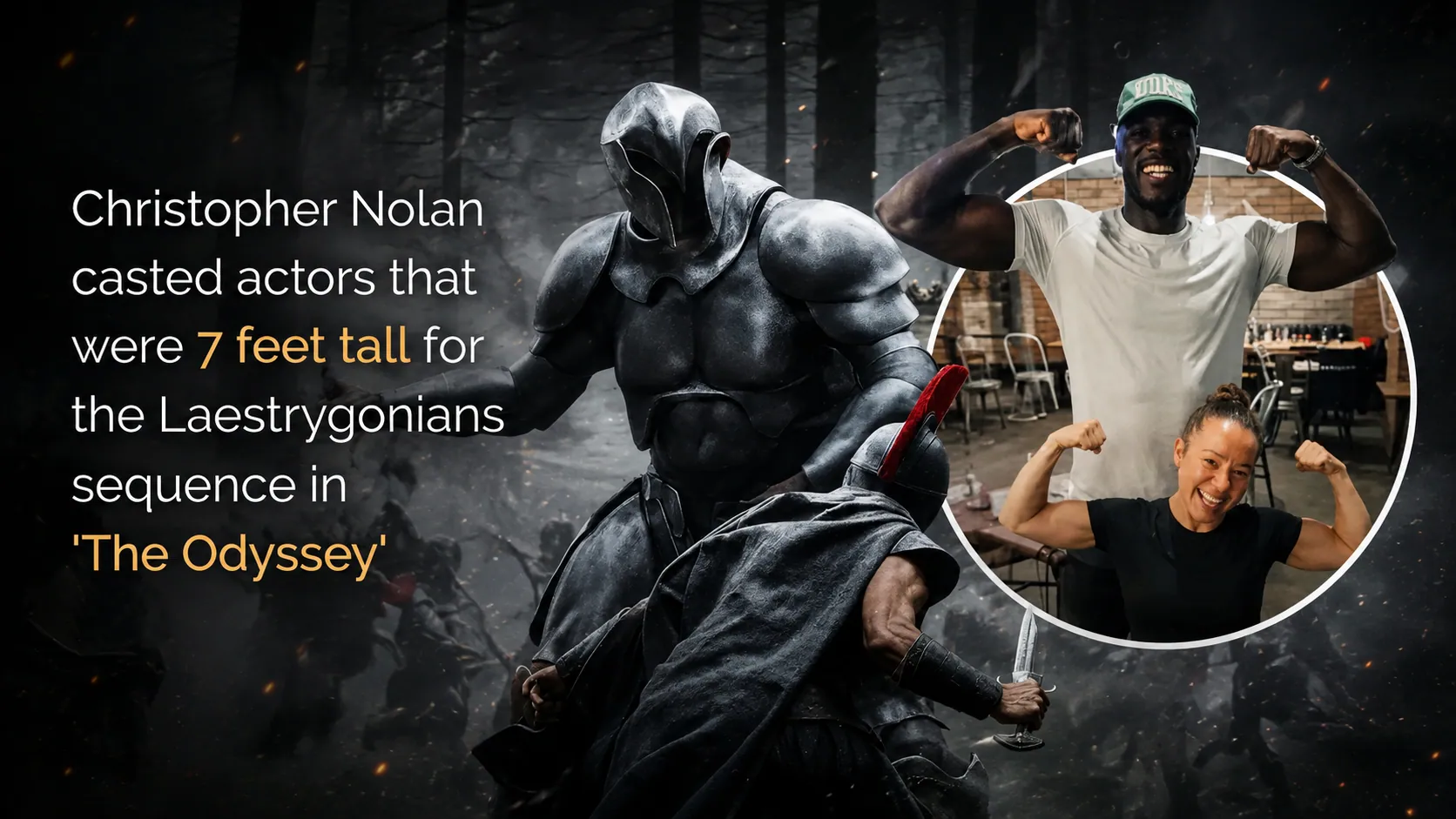
When Christopher Nolan wanted the Laestrygonians in The Odyssey to feel genuinely enormous, he reportedly took a surprisingly simple approach: put very tall performers next to very short ones.
Matt Damon has revealed that the film’s giant sequence used practical scale differences, with stunt performers around seven feet tall paired with performers under five feet. The technique helped create the intimidating size of the Laestrygonians without depending primarily on digital enlargement.
The result is exactly the kind of filmmaking detail that has made Nolan’s practical-effects approach a frequent topic of discussion. Instead of asking visual effects artists to create the entire illusion from scratch, the production began with something viewers could actually see and photograph: real people with a dramatic difference in height.
How Christopher Nolan Made The Odyssey’s Giants Look So Tall
The key technique was forced perspective and practical scale manipulation.
In Damon’s account, the Laestrygonians were portrayed using stunt performers who were about seven feet tall, while the stunt performers interacting with them were under five feet. Put together carefully within the same cinematic space, that difference immediately makes the giants appear far more imposing.
The approach is especially effective because the audience is not simply looking at a digitally enlarged character. The actors are physically present in the scene, with real bodies, real movement and real interactions with the environment.
That physicality can make a major difference. A giant who occupies the same space as the other performers naturally creates visual cues that are difficult to replicate convincingly with a purely digital solution.
Matt Damon’s Stunt Double Added Another Layer to the Illusion
One of the more unexpected details from the production involves Matt Damon’s stunt double.
Damon said his double for some of the action was a female stunt performer, later identified in reports as Devyn Dalton. Dalton is around 4 feet 6 inches tall and has extensive experience in physically demanding stunt work, making her unusually well suited to scenes designed around dramatic differences in scale.
Damon reportedly praised her athletic ability and joked about her remarkably muscular arms. Her smaller stature also helped exaggerate the apparent size of the towering Laestrygonians when the camera placed her opposite the much taller performers.
It is a clever example of how stunt casting can serve more than one purpose. The performer has to be capable of executing the physical demands of the scene, but in this case, her height also became part of the visual storytelling.
Why the Practical Approach Matters
The Laestrygonian sequence is a good example of the difference between creating an effect and creating the conditions for an effect.
Digital visual effects can make a performer appear taller, larger or more powerful. But when filmmakers begin with real physical differences, the camera captures natural details automatically: the way bodies move, how clothing hangs, how shadows fall and how performers react to one another.
That does not mean digital effects are absent from the finished movie. Modern productions often combine practical photography with visual effects, compositing and digital cleanup. The important distinction is that Nolan’s approach, as described in reporting on the sequence, used real scale differences as a foundation rather than relying entirely on CGI to invent the giants after filming.
This philosophy fits with the broader production style associated with The Odyssey. Reports have highlighted the film’s use of practical techniques and real-world environments, including large physical elements and on-location filmmaking designed to give the images a tangible quality.
The Laestrygonians Are a Perfect Test for Scale
In Homer’s epic, the Laestrygonians are not ordinary enemies. They are giant inhabitants whose size helps turn Odysseus’ journey into a terrifying encounter.
That means their physical scale is central to the scene. If the audience does not believe that these figures are truly enormous, much of the threat disappears.
Nolan’s solution therefore serves the story as much as it serves the visual effects. The audience is meant to feel that Odysseus and his crew are suddenly dealing with beings who exist on a completely different physical scale.
The height difference between performers gives the camera an immediate visual language: one group dominates the frame, while the other appears vulnerable.
Why Viewers Are Talking About the Technique
The behind-the-scenes revelation has attracted attention because it represents a kind of movie magic many viewers find increasingly fascinating.
Audiences are accustomed to seeing digital effects used to create impossible creatures and enormous characters. Learning that a major part of the illusion began with casting performers of dramatically different heights makes the scene feel almost deceptively simple.
That simplicity is part of the appeal.
As fans discussed the technique online, many compared the idea with classic scale tricks used in fantasy filmmaking, including the practical methods associated with The Lord of the Rings. The comparison reflects a broader appreciation for visual effects that begin with real sets, real performers and carefully planned camera work.
Of course, the comparison should not be taken to mean that every technique is identical. Different productions use different combinations of forced perspective, scale doubles, set construction and compositing. But the basic principle remains powerful: the camera can create a convincing illusion when filmmakers carefully control what is physically in front of it.
The Real Lesson Behind Nolan’s Giant Movie Trick
The most interesting part of the Laestrygonian sequence may be that the trick was decided before the camera rolled.
The production did not simply wait until post-production and ask a computer to make the giants look bigger. Instead, the filmmakers created a real physical contrast and then designed the photography around it.
That decision affects everything from casting to choreography and camera placement. The stunt performers must be able to move safely together. The camera must preserve the intended scale relationship. The environment has to support the illusion rather than accidentally revealing it.
In other words, the effect works because the details are planned from the beginning.
A Practical Illusion With a Big Impact
Christopher Nolan’s use of roughly seven-foot stunt performers alongside performers under five feet shows why practical filmmaking can remain so effective in the digital era.
The Laestrygonians may be mythological giants, but the basic visual idea behind their size is remarkably real: place a very tall performer next to a much shorter one, frame the moment carefully and let the physical difference do much of the work.
That does not eliminate the need for modern visual effects. Instead, it gives those effects something authentic to build on.
And that may be the real reason the technique has captured so much attention. Sometimes the most convincing movie magic does not begin with a computer-generated image. It begins with a casting decision, a camera angle and two performers whose real-world height difference makes an impossible world feel just a little more believable.