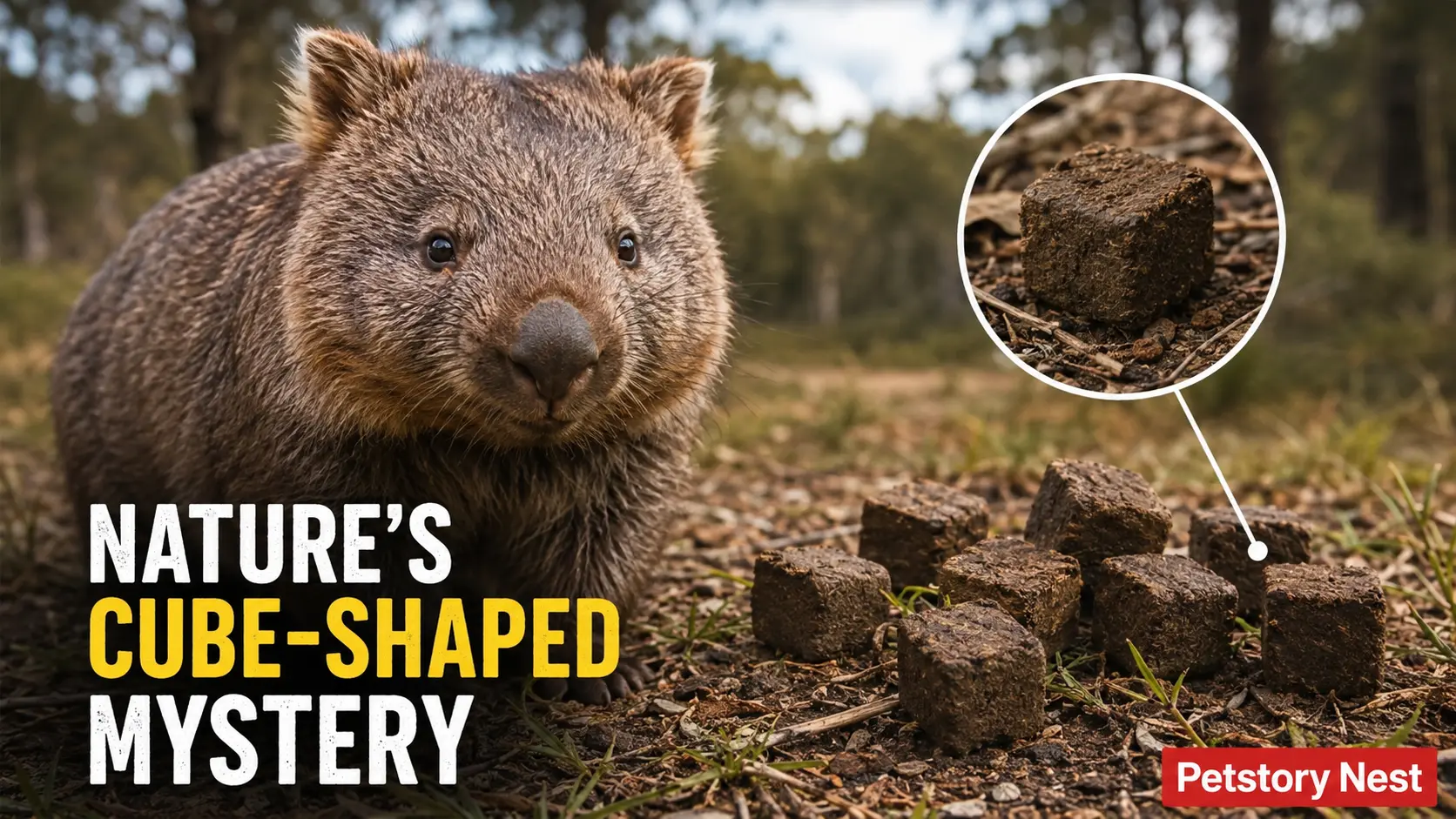
A wombat walking through the Australian bush may look like an ordinary, sturdy marsupial, but its digestive system produces something remarkably unusual: cube-shaped feces. Wombats are the only known animals to produce naturally cubic droppings, making the behavior one of the strangest examples of adaptation in the animal kingdom.
The unusual shape is not created by a square-shaped opening, as one popular explanation once suggested. Research has shown that the cubes form inside the wombat’s intestine, where differences in the stiffness and elasticity of intestinal tissue help shape the material as it moves toward the anus.
Why Do Wombats Produce Cube-Shaped Poop?
The primary keyword for this fascinating biological mystery is cube-shaped wombat poop, and the answer lies largely in the animal’s unusual digestive anatomy.
Researchers studying wombat intestines found that different sections of the intestinal wall have different mechanical properties. Some regions are relatively stiff, while others are more flexible. As intestinal contractions move the material through the colon, those differences help create the flat surfaces and corners characteristic of the cubes.
This means the distinctive shape develops gradually inside the digestive tract rather than being stamped out at the very end of the digestive process.
A Georgia Institute of Technology account of the research notes that investigators found the cubic material forming in the intestine itself. That finding helped rule out the old idea that the shape was produced by a square-shaped sphincter.
The Wombat’s Unusual Digestive System
Wombats have remarkably long intestines. Researchers examining wombat anatomy found that their intestines can measure roughly 33 feet in length, longer than the average human intestinal tract. The extended digestive system also helps remove substantial amounts of water from food waste, leaving the resulting feces relatively dry.
Dryness matters because the final material needs to maintain its shape.
Research published in Soft Matter found that wombat feces develop their corners through intestinal contractions combined with the intestine’s unusual non-uniform material properties. The study described how differences in tissue stiffness can create the geometry that eventually produces the cube-like form.
Scientists have even used mathematical and physical models to explore how different intestinal properties could generate different shapes. The work provides a remarkable example of how biomechanics can explain something that initially seems almost impossible.
Why Would Cube-Shaped Droppings Be Useful?
The shape may have an important role beyond simply being an odd biological curiosity.
Wombats use feces as scent markers, particularly around the boundaries of their home ranges. Their droppings can be placed in visible locations such as rocks, where the flat surfaces help prevent the pieces from rolling away.
That could make the cubes especially useful for communication.
Scientists have suggested that the larger surface area and stable shape may help with scent marking and olfactory communication. Territorial scent marking is common among mammals, and fecal markings can communicate information about territory and potentially social or reproductive status.
However, it is important to separate what scientists have demonstrated from what remains a hypothesis. Researchers have strong evidence explaining how the cubes form, while the precise evolutionary reason for their cubic shape is less certain.
Not All Wombat Droppings Look Exactly the Same
Although the cube shape is the famous feature, wombat feces are not necessarily perfect geometric blocks.
The shape develops through the interaction of intestinal movement, tissue stiffness, moisture and the physical properties of the material. As the feces become drier, they become more solid and can retain their distinctive form.
Research has also examined how fecal material changes as it travels through the intestine. The work shows that the transformation from softer material to formed cubes happens progressively within the digestive tract.
That makes the phenomenon much more interesting than the simple idea that wombats somehow “make square poop.”
A Biological Puzzle That Won a Scientific Prize
The unusual subject has also played an unexpected role in scientific research.
David Hu and colleagues at Georgia Tech studied the mechanics behind wombat feces and received the 2019 Ig Nobel Prize for their work. The Ig Nobel awards recognize research that can initially make people laugh but ultimately encourages them to think about science.
The research demonstrates why seemingly strange questions can have serious scientific value.
Understanding how biological tissues create specific shapes can help researchers learn more about soft materials, mechanical forces and how living systems produce structures without rigid molds.
In fact, researchers have suggested that studying the mechanics of biological tissues could have applications beyond wildlife biology. The Georgia Tech research highlighted the broader scientific value of understanding how soft materials deform and create different geometries.
Wombats Turn an Oddity Into a Survival Strategy
For anyone encountering wombat droppings in the Australian landscape, those small cubes are more than a curiosity.
They are part of the animal’s communication system and provide clues about where wombats live and move. Researchers have documented cubic feces around wombat home ranges, including on rocks used as marking locations.
The stable shape is particularly useful in these locations because conventional pellet-shaped droppings could easily roll away.
This is a good example of how evolution can produce solutions that appear bizarre from a human perspective but make sense within an animal’s environment.
One of Nature’s Most Unusual Adaptations
Wombats may be best known for their sturdy bodies, burrowing lifestyle and distinctive appearance, but their digestive system offers one of the animal kingdom’s most extraordinary biological surprises.
The science behind cube-shaped wombat poop shows that the phenomenon comes from the interaction between intestinal contractions and regions of different stiffness within the colon. The resulting shape may also help the animals leave stable scent markers around their territories.
What looks like a funny wildlife fact is therefore a fascinating lesson in anatomy, biomechanics and animal behavior. The wombat’s unusual digestive system demonstrates just how creatively nature can solve everyday survival problems.