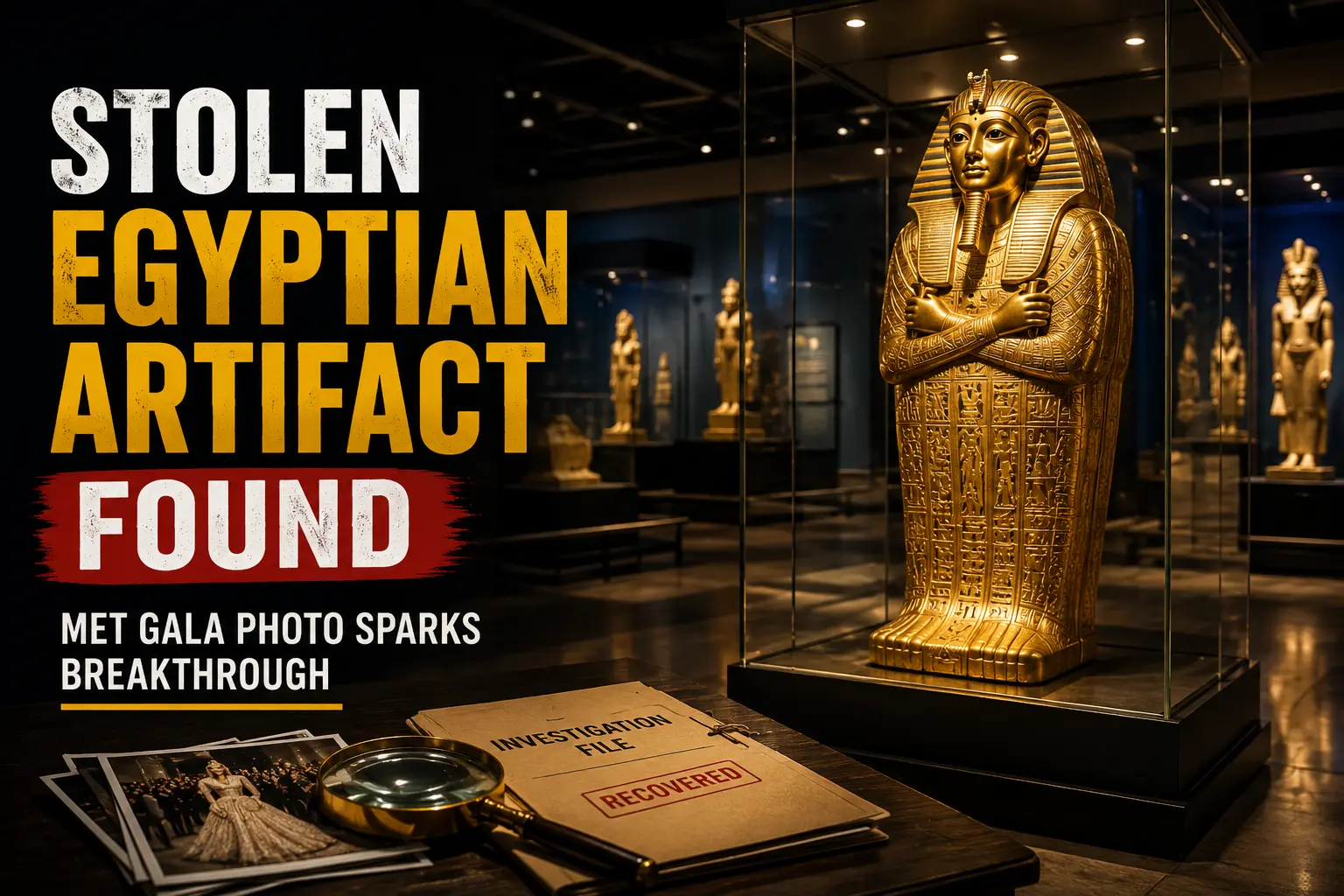
A Celebrity Snapshot That Took an Unexpected Turn
When Kim Kardashian attended the 2018 Met Gala, one photograph quickly spread across social media. Dressed in a gold gown, she posed beside an ornate golden Egyptian sarcophagus inside New York’s Metropolitan Museum of Art. At the time, it appeared to be another glamorous celebrity moment from one of fashion’s biggest nights.
Months later, however, that same image became associated with a remarkable cultural heritage story. While Kim Kardashian had no role in any investigation, the widespread attention surrounding the photograph coincided with renewed public interest in the ancient artifact, which was later returned to Egypt after authorities determined it had been illegally removed from the country.
The story serves as a fascinating example of how a viral photo can unexpectedly intersect with history, archaeology, and international efforts to protect cultural treasures.
The Ancient Coffin of Nedjemankh
The artifact featured in Kim Kardashian’s Met Gala photo was the gilded coffin of Nedjemankh, an Egyptian priest believed to have lived more than 2,100 years ago during the Ptolemaic period.
Experts considered the coffin an extraordinary archaeological masterpiece. Covered in intricate hieroglyphics and decorated with detailed religious artwork, it reflected the craftsmanship and spiritual beliefs of ancient Egypt.
Because of its historical importance and exceptional condition, the coffin attracted worldwide attention after arriving in New York.
How the Coffin Reached the Metropolitan Museum
In 2017, New York’s Metropolitan Museum of Art purchased the coffin for nearly $4 million from international art dealers.
At the time of the acquisition, the museum believed the paperwork proving the artifact’s legal export from Egypt was legitimate. The documentation appeared to show that the coffin had left Egypt decades earlier.
Based on those records, the purchase moved forward, and the coffin became part of the museum’s celebrated collection, where thousands of visitors viewed it each year.
Unfortunately, investigators would later discover that the documents supporting the sale were fraudulent.
Why Kim Kardashian’s Photo Drew So Much Attention
During the 2018 Met Gala, celebrities toured exhibits inside the Metropolitan Museum before walking the famous red carpet.
Kim Kardashian’s gold dress matched the brilliant appearance of the ancient coffin, making the image especially eye-catching. The photograph quickly circulated across news outlets, entertainment websites, and social media platforms around the world.
Although the picture did not trigger the investigation by itself, its enormous visibility helped keep the artifact in the public spotlight as authorities continued examining questions surrounding its history and ownership.
It’s important to note that Kim Kardashian was never accused of wrongdoing and has never claimed credit for the coffin’s recovery.
Investigators Uncover the Truth
As investigators reviewed the artifact’s documented history, new evidence emerged showing that the coffin had likely been looted during the political instability that affected Egypt after the 2011 revolution.
Authorities concluded that forged documents had been used to create a false ownership history, allowing the artifact to enter the international art market.
Working together, Egyptian officials, prosecutors, and investigators in New York traced the coffin’s journey and determined that it had been unlawfully exported from Egypt.
The case highlighted the growing challenge museums face when acquiring valuable antiquities whose ownership records may appear authentic but later prove to be fabricated.
The Coffin Returns Home
In 2019, after the investigation confirmed the fraudulent documentation, the Metropolitan Museum of Art voluntarily returned the coffin to Egypt.
Museum officials acknowledged that they had relied on false records during the purchase and cooperated with authorities throughout the investigation.
The return represented an important victory for international efforts to recover cultural artifacts that have been illegally removed from their countries of origin.
Today, the coffin belongs once again to Egypt, where it forms part of the nation’s rich archaeological heritage.
Why This Case Matters Beyond One Artifact
The story of the Nedjemankh coffin extends far beyond a single museum exhibit.
Across the world, governments, museums, and law enforcement agencies continue working together to identify and recover cultural objects that were stolen or trafficked illegally.
Advances in digital archives, international cooperation, and increased public awareness have made it easier to investigate suspicious ownership histories. Cases like this also encourage museums to strengthen their acquisition procedures and conduct even more thorough provenance research before purchasing ancient artifacts.
Public Reaction and Online Interest
When news of the coffin’s return became public, many people expressed support for sending the artifact back to Egypt.
The unusual connection between a Met Gala celebrity photo and an international cultural heritage investigation also sparked widespread curiosity online. Readers were fascinated that an image originally shared for fashion coverage had become linked to one of the art world’s most notable restitution cases.
The story continues to circulate because it combines celebrity culture, ancient history, and the protection of priceless historical objects in a way few people would expect.
Separating Fact From Fiction
Several social media posts suggest that Kim Kardashian personally helped investigators recover the coffin.
That claim is misleading.
The verified facts show that Kim Kardashian was simply photographed beside the artifact during the Met Gala. She was not involved in the investigation, did not assist law enforcement, and has never taken credit for the coffin’s return.
Her viral photograph became an unexpected visual reference connected to a much larger investigation that was already unfolding behind the scenes.
Final Thoughts
The journey of the Nedjemankh coffin is a reminder that history often resurfaces in surprising ways. What began as a glamorous Met Gala photograph ultimately became associated with the return of a priceless artifact that had spent centuries preserving the story of an ancient Egyptian priest.
For Kim Kardashian, it was simply another event photo. For historians and investigators, however, the image became an unforgettable symbol of a case that reinforced the importance of protecting cultural heritage and ensuring that irreplaceable historical treasures find their rightful home.