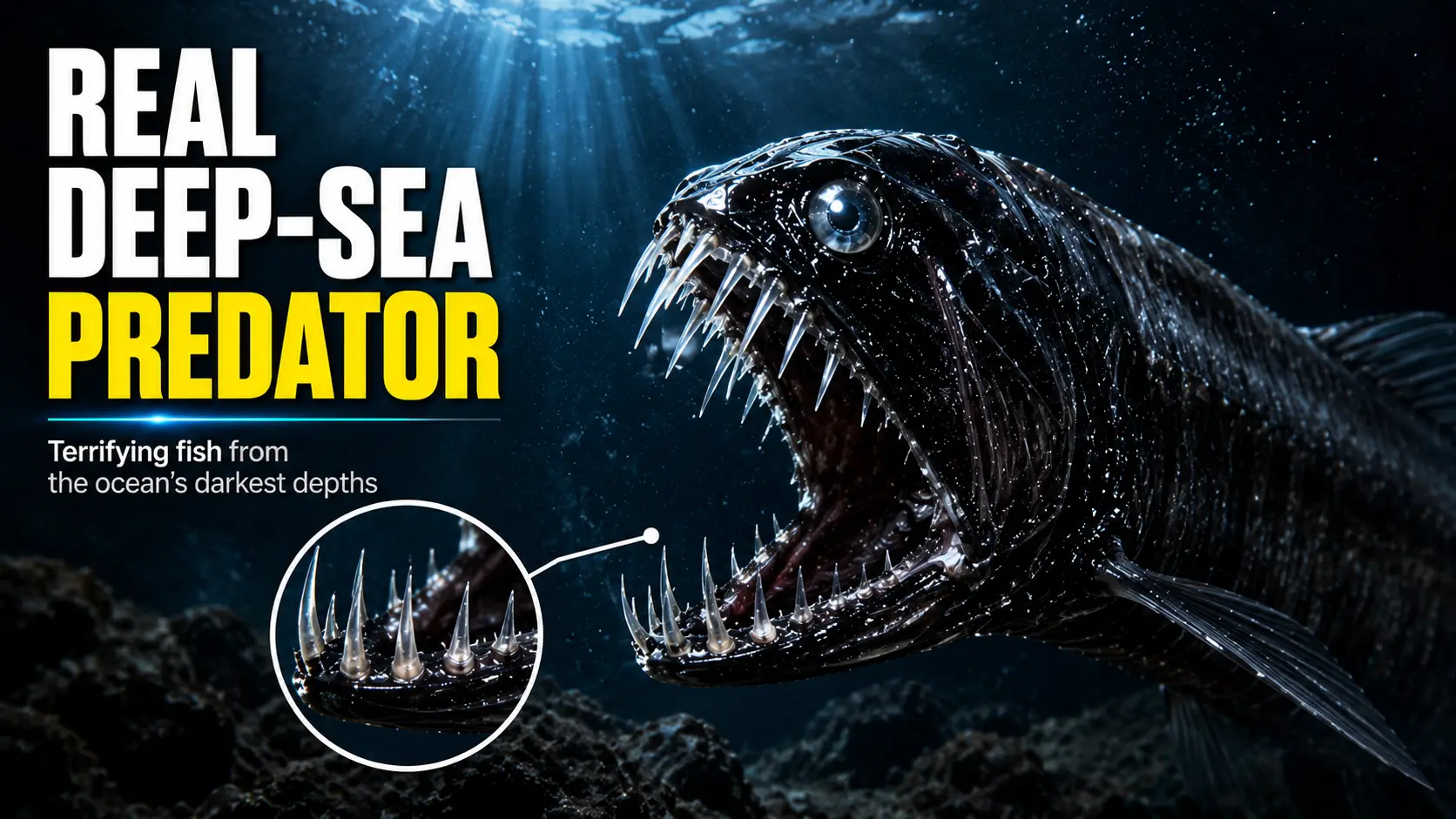
The deep ocean has long been a place of mystery, hiding creatures so unusual they often seem impossible. One deep-sea fish that looks like the Alien movie monster has recently captured people’s attention for exactly that reason. With its jet-black body, needle-like teeth, and haunting appearance, the fish has sparked comparisons to the terrifying creature from the Alien film franchise.
While its appearance may seem like something imagined by Hollywood, this remarkable animal is very real. It survives in one of the harshest environments on Earth, where sunlight never reaches and food is scarce. Scientists say its frightening features are not designed to scare people—they are simply the result of millions of years of evolution.
Why This Deep-Sea Fish Resembles the Alien Movie Monster
At first glance, it’s easy to understand why people make the comparison. The fish has a glossy black body that blends into the darkness of the deep ocean. Its oversized mouth is lined with razor-sharp, transparent teeth that can trap prey before it has a chance to escape.
Its large eyes, elongated head, and eerie silhouette give it a truly otherworldly appearance. Combined with the darkness of its habitat, the fish looks more like a science-fiction creature than an animal living on our own planet.
Social media users have described it as “nightmare fuel” and “proof that aliens already exist under the sea.” While these reactions are playful, they reflect just how unusual deep-sea life can appear to those who have never seen it before.
Life Thousands of Feet Below the Surface
The deep ocean is one of the least explored places on Earth. At depths of several thousand feet, there is no sunlight, temperatures remain close to freezing, and pressure is hundreds of times greater than at sea level.
Living in such conditions requires extraordinary adaptations.
Many deep-sea fish have evolved dark skin to remain nearly invisible. Others produce their own light through a process called bioluminescence, using glowing organs to attract prey or communicate with potential mates.
The fish drawing comparisons to the Alien creature relies on stealth, camouflage, and powerful jaws to survive where every meal matters.
Sharp Teeth Serve a Practical Purpose
Although its mouth looks terrifying, every feature has a survival advantage.
Food is difficult to find in the deep sea. Animals may go days or even weeks without eating, so when prey appears, they cannot afford to let it escape.
The fish’s long, curved teeth help grip slippery prey such as smaller fish, squid, and crustaceans. Many deep-sea predators also have flexible jaws and expandable stomachs, allowing them to swallow surprisingly large meals whenever the opportunity arises.
These adaptations may appear frightening to humans, but they are perfectly suited to an environment where survival depends on making the most of every feeding opportunity.
Evolution Shaped a Perfect Deep-Sea Predator
Scientists emphasize that strange-looking animals are often highly specialized rather than dangerous.
Over millions of years, natural selection has produced creatures capable of thriving under crushing pressure and complete darkness. Features that seem monstrous from a human perspective actually solve very specific survival challenges.
Dark coloration provides camouflage. Sensitive eyes detect faint traces of light. Sharp teeth prevent prey from escaping. Every unusual characteristic has a practical function.
This is why marine biologists often describe deep-sea animals as some of evolution’s most impressive achievements.
Why the Deep Ocean Still Holds So Many Mysteries
Despite decades of research, experts estimate that much of the deep ocean remains unexplored.
The extreme depth, immense pressure, and vast size of the world’s oceans make exploration difficult and expensive. Modern remotely operated vehicles and deep-sea submarines have revealed incredible new species, yet researchers believe countless others are still waiting to be discovered.
Each expedition brings surprising discoveries, from glowing jellyfish to bizarre fish with transparent heads and giant mouths.
These findings remind scientists that our understanding of Earth’s largest habitat is still incomplete.
Public Fascination Continues to Grow
Whenever unusual deep-sea animals appear online, they often become viral sensations.
People are naturally fascinated by creatures that challenge their expectations of life on Earth. Comparisons to famous movie monsters, especially the iconic Alien creature, make these discoveries even more memorable.
Marine scientists generally welcome this attention because it encourages curiosity about ocean research and biodiversity. Viral images often inspire people to learn more about marine ecosystems, conservation, and the importance of protecting the world’s oceans.
A Reminder That Nature Can Be Stranger Than Fiction
The deep-sea fish that resembles the monster from the Alien movies may look terrifying, but it is simply another example of nature adapting to extraordinary conditions.
Its glossy black body, razor-sharp teeth, and eerie appearance were shaped by the demands of life in perpetual darkness, not by science fiction. Every feature serves a purpose in helping it survive where few other animals can.
As technology allows scientists to explore deeper than ever before, discoveries like this remind us that some of Earth’s greatest mysteries are not found in outer space—they are hidden beneath the waves. The deep ocean remains one of the planet’s final frontiers, filled with astonishing creatures that continue to surprise even experienced researchers.